
This article about What eats snakes? Who Animals that hunt and eat snakes. Snakes are incredibly diverse and fascinating creatures, known for their unique anatomy, hunting abilities, and important role in ecosystems. From the venomous mamba to the non-venomous corn snake, snakes come in various shapes and sizes, each with its own specialized way of hunting and surviving.
What eats snakes? Here’s a list of animals that hunt and eat snakes:
1. Birds of Prey
- Eagles (e.g., Golden eagle, Bald eagle)
- Hawks (e.g., Red-tailed hawk)
- Owls (e.g., Barn owl, Great horned owl)
- Kites (e.g., Swallow-tailed kite)
2. Mammals
- Mongooses (e.g., Indian mongoose)
- Raccoons
- Wild cats (e.g., Jaguars, Ocelots, Leopards)
- Honey badgers
- Foxes
- Coyotes
- Badgers
- Lions (occasionally)
3. Reptiles
- Crocodiles and Alligators
- Monitor lizards (e.g., Komodo dragon, Nile monitor)
- Tegus
- Large snakes (e.g., King cobra, pythons, and boas can eat smaller snakes)
4. Amphibians
- Large frogs (e.g., Cane toad)
- Salamanders (occasionally)
5. Humans
- Some cultures hunt and consume snakes for food, medicine, or as a tradition.
These animals are typically skilled hunters that can overpower, catch, and eat snakes, and their hunting methods vary greatly depending on the species.
1. Red-tailed Hawks:
Red-tailed Hawks are a type of bird of prey belonging to the family Accipitridae, known for their keen eyesight, powerful talons, and exceptional hunting skills. They are among the most efficient hunters in the bird world. Here’s more information about what eats snakes about hawks:
Key Characteristics of Hawks:
- Sharp Vision: Hawks are known for their excellent eyesight, which is up to 8 times more powerful than that of humans. This allows them to spot prey from great distances while flying.
- Talons and Beak: Hawks have strong, sharp talons and hooked beaks designed to capture and tear apart their prey. Their talons are used to grasp and immobilize prey, and their beaks are adapted to rip flesh.
- Wingspan: Hawks typically have broad, long wings that enable them to soar and glide for long distances while hunting.
- Feathers: Hawks have specialized feathers that allow them to fly silently and efficiently, which helps them approach prey unnoticed.
Types of Hawks:
There are several species of hawks, with the most common being:
- Red-tailed Hawk
- One of the most widespread hawks in North America, recognizable by its reddish-brown tail.
- It primarily hunts small mammals, birds, and reptiles, including snakes.
- Cooper’s Hawk
- Known for its ability to maneuver through dense forests while hunting birds.
- They prey mostly on medium-sized birds and occasionally small mammals.
- Sharp-shinned Hawk
- Smaller than Cooper’s hawk, it also preys on birds and is adept at flying through dense cover.
- Northern Harrier
- Often seen flying low over fields and wetlands, it hunts small mammals, birds, and reptiles.
- Its hunting style is distinctive, as it flies close to the ground while looking for prey.
- Broad-winged Hawk
- Known for migrating in large groups and hunting smaller animals, particularly insects and small mammals.
- Swainson’s Hawk
- Found in North America, it is a migratory hawk that hunts insects, small mammals, and birds.
Diet:
Hawks are carnivorous and feed on a wide variety of prey, depending on their species and habitat. Common prey includes:
- Small mammals (e.g., rodents, rabbits, squirrels)
- Birds (e.g., songbirds, doves, quail)
- Reptiles (e.g., snakes, lizards)
- Insects (for smaller species)
Hunting and Behavior:
- Hunting Style: Hawks are known for their varied hunting methods, which can include:
- Perch hunting: Waiting on a high perch and scanning the ground for prey.
- Gliding and soaring: Some hawks soar to great heights and then swoop down to capture prey from above.
- Stalking: Particularly for smaller hawks like the Cooper’s hawk, they may quietly approach their prey through trees or underbrush.
Habitat:
Hawks are found in a wide range of habitats, including:
- Forests
- Grasslands
- Wetlands
- Deserts
- Urban areas (where some species adapt to city life)
Reproduction:
- Hawks generally build large nests, often in tall trees or cliffs.
- They lay a few eggs (typically 1-5) that hatch after a few weeks of incubation.
- Both parents participate in feeding and protecting the young.
Conservation Status:
While many hawk species are common and widespread, some are threatened or endangered due to habitat loss, pesticide use, and human persecution. Conservation efforts are in place to protect many species.
Fun Fact:
- Hawks are skilled at hunting snakes. Their keen eyesight allows them to spot snakes from high in the sky, and their powerful talons can subdue and kill these reptiles quickly.
2. Secretary Bird
The Secretary Bird (Sagittarius serpentarius) is a large, unique bird of prey native to sub-Saharan Africa. Known for its distinctive appearance and exceptional hunting abilities, it is particularly famous for hunting and eating snakes. Here’s more what eats snakes about this fascinating bird:
Key Characteristics of the Secretary Bird:
- Distinctive Appearance:
- The secretary bird has a tall, slender body, long legs, and a distinctive crest of feathers on the back of its head, which resemble quill pens sticking out of an inkwell—hence the name “Secretary Bird.”
- It has long, powerful legs, which help it chase down and kill prey, particularly snakes.
- Size:
- Secretary birds are large birds, standing about 3.3 to 4 feet (1 to 1.2 meters) tall.
- They have a wingspan of around 6 to 7 feet (1.8 to 2.1 meters).
- Habitat:
- Secretary birds are found in open grasslands, savannas, and shrublands across sub-Saharan Africa.
- They prefer areas with sparse vegetation, which allows them to see and hunt their prey more effectively.
- Diet:
- They are primarily carnivorous and prey on a wide range of animals, including insects, small mammals, and reptiles—particularly snakes.
- Secretary birds are known to hunt and kill venomous snakes like cobras, vipers, and adders.
- Hunting and Hunting Techniques:
- Snake Killers: Secretary birds are exceptional snake hunters. They use their long legs to stomp on snakes, delivering powerful kicks to immobilize or kill them. They target the snake’s head or neck, often breaking its spine with a single, swift blow.
- Speed and Agility: These birds are known for their agility and speed on the ground, often chasing down snakes and striking them with lightning-fast kicks.
- They also hunt a variety of other prey, including insects, lizards, and small mammals, which they catch with their sharp beaks and talons.
- Behavior:
- Unlike many other birds of prey, secretary birds hunt primarily on the ground rather than from the air. They can cover large areas in search of prey, walking with a characteristic gait while scanning the ground for potential meals.
- When hunting, they typically stomp or kick at their prey, using their long legs to deliver powerful strikes. For snakes, they usually target the head to subdue or kill it.
How Secretary Birds Kill Snakes:
- Powerful Kicks: The secretary bird uses its strong legs to stomp or kick venomous snakes, effectively killing them by breaking their back or crushing their skull. These kicks can be so forceful that they are capable of breaking bones or rendering the snake motionless.
- Speed: Secretary birds are incredibly fast, and they can move swiftly in pursuit of a snake. Once they’ve caught their prey, they don’t hesitate to strike with precision.
- Stomping: The bird may stomp on the snake to disorient it, and then it will usually crush the snake’s head or break its back to neutralize the threat. This makes them highly effective at taking on venomous snakes that would pose a danger to other predators.
Reproduction and Nesting:
- Secretary birds build large nests in tall trees, often creating a platform made of sticks and other materials. Both parents participate in building the nest and caring for the young.
- They lay 1 to 3 eggs per breeding season, and both parents share incubation duties.
- The chicks are raised in the nest until they are able to fly and hunt on their own, which takes several months.
Conservation Status:
- The secretary bird is classified as Vulnerable by the International Union for Conservation of Nature (IUCN), primarily due to habitat loss, poisoning, and human-wildlife conflict.
- Efforts to protect their habitats and reduce threats like pesticide use and loss of prey are important for their conservation.
Fun Fact:
- The secretary bird’s name comes from its resemblance to a secretary, particularly in the way the bird holds its head high and the crest of feathers on its head, which look like quill pens tucked behind an ear.
Snake-Eating Abilities:
- Secretary birds are among the few birds that specialize in hunting and killing venomous snakes, making them unique among birds of prey.
- They are skilled in dispatching even large or dangerous snakes, such as cobras, using their powerful legs and fast reflexes.
3. Owls:
Owls are nocturnal birds of prey that belong to the order Strigiformes. They are known for their unique appearance, silent flight, and exceptional hunting abilities, especially in low light conditions. Here’s more information what eats snakes about owls:
Key Characteristics of Owls:
- Facial Discs: Owls have distinctive round or heart-shaped facial discs that help funnel sound to their ears, enhancing their ability to hear prey even in complete darkness.
- Silent Flight: Owls are known for their ability to fly silently, thanks to specialized wing feathers that reduce noise. This allows them to approach prey without being detected.
- Exceptional Vision and Hearing: Owls have excellent night vision, allowing them to hunt in low light. Their hearing is also incredibly sharp, with some species able to locate prey based on sound alone.
- Large Eyes: Most owls have large, forward-facing eyes, which provide binocular vision and depth perception. However, they cannot move their eyes and must turn their heads to look around.
- Rotatable Neck: Owls have highly flexible necks, capable of rotating up to 270 degrees, allowing them to scan their surroundings without moving their bodies.
- Sharp Talons and Beaks: Owls have strong talons for grabbing and killing prey, as well as a sharp, hooked beak for tearing apart food.
Types of Owls:
There are around 200 species of owls, which can be classified into two main families:
- Strigidae (Typical Owls): These owls generally have rounded faces and are found in a wide range of habitats. Examples include:
- Barn Owl (recognizable by its heart-shaped face)
- Great Horned Owl (large owl with tufts on its head)
- Eastern Screech Owl (small owl with a distinctive call)
- Northern Saw-whet Owl
- Tytonidae (Barn Owls): These owls typically have a more heart-shaped face and are found in many parts of the world. The Barn Owl is the most well-known of this group.
Diet:
Owls are carnivorous, and their diet consists mostly of:
- Small mammals (e.g., rodents, rabbits, squirrels)
- Birds (e.g., songbirds, small waterfowl)
- Reptiles (e.g., lizards, snakes)
- Insects (especially for smaller owl species)
Some larger owls, like the Great Horned Owl, can also hunt larger prey, including other birds of prey.
Hunting and Behavior:
- Nocturnal Hunting: Most owls are nocturnal hunters, using their excellent night vision and acute hearing to locate prey in the dark.
- Stealth and Silence: Their silent flight allows owls to approach their prey without being detected. The structure of their wings and feathers contributes to this quiet flight.
- Hunting Techniques: Owls usually hunt from a perch, silently flying down to capture prey, or they may glide through the air, swooping down to grab their catch.
Habitat:
Owls can be found in a variety of habitats, including:
- Forests
- Grasslands
- Deserts
- Wetlands
- Urban areas (some species adapt to city environments)
Some species, such as the Barn Owl, are also found in agricultural areas, where they hunt rodents.
Reproduction:
- Owls typically build nests in hollow trees, cliffs, or other sheltered areas, and some species may use abandoned nests of other birds of prey.
- Female owls usually lay between 2 to 4 eggs, which they incubate for several weeks. After hatching, the parents take turns feeding and protecting the young.
Conservation Status:
While many owl species are widespread and common, some are threatened or endangered due to habitat loss, hunting, and pollution. Conservation efforts focus on protecting owl habitats and reducing threats from human activity.
Fun Facts:
- Barn Owls are known to have an incredible ability to hunt rodents and are often used in agricultural settings as natural pest controllers.
- Some owls, like the Great Horned Owl, are known to prey on other birds of prey, including smaller owls.
- Owls are often considered symbols of wisdom and mystery in various cultures.
Species of Owls:
- Barn Owl: Known for its heart-shaped face and widespread presence around the world.
- Great Horned Owl: A large owl with tufted ears and known for its hoot.
- Snowy Owl: Iconic with its white feathers, often found in Arctic regions.
- Eastern Screech Owl: Small and highly adaptable to various environments.
- Long-eared Owl: Recognizable by its long ear tufts.
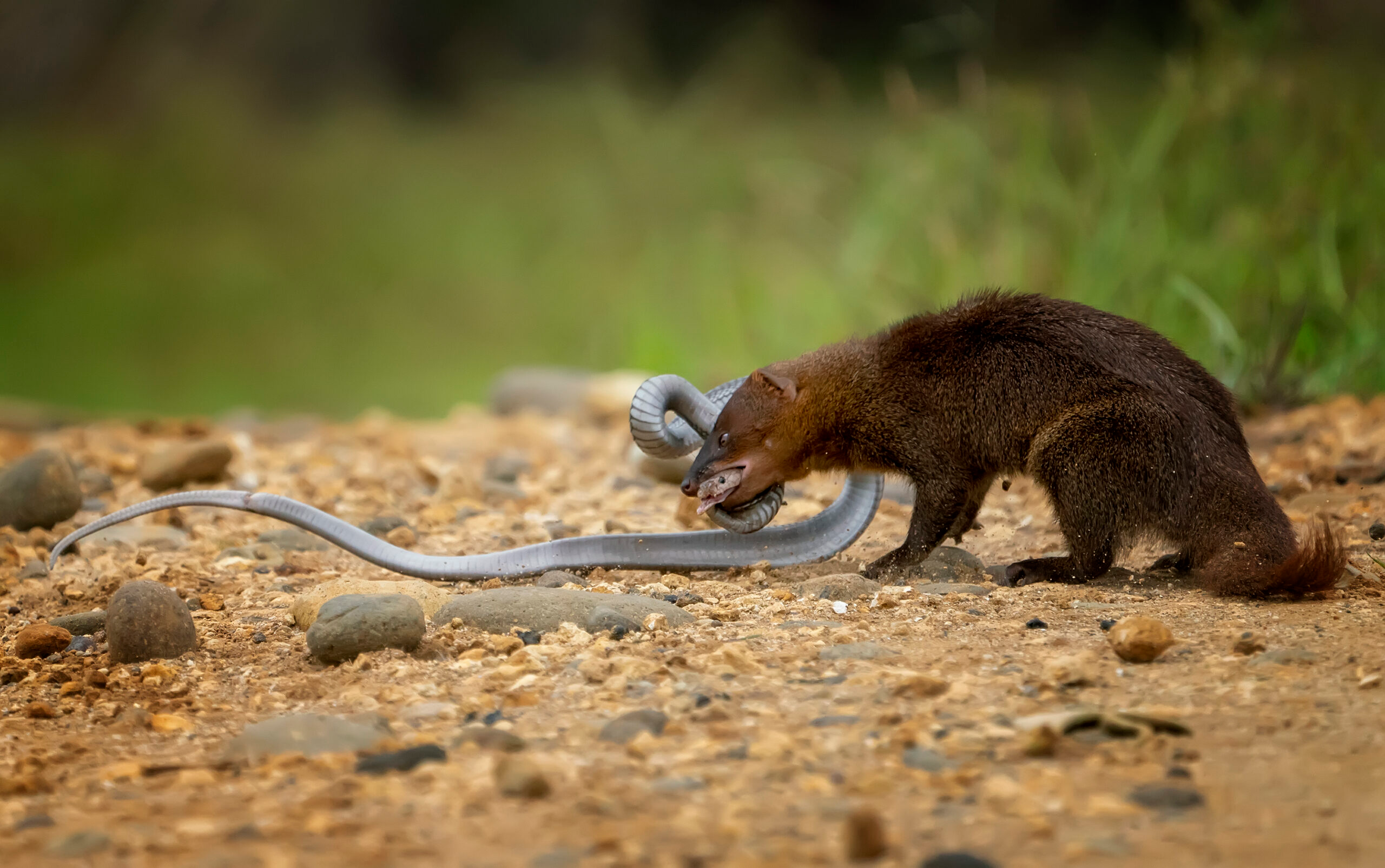
4. Mongooses:
What eats snakes? Yes, mongooses are known to eat snakes. They are particularly famous for their ability to hunt and kill venomous snakes. Mongooses are highly agile and quick, and they have some natural adaptations that help them in snake hunting:
Key Adaptations of Mongooses for Hunting Snakes:
- Speed and Agility: Mongooses are fast and nimble, which allows them to dodge a snake’s strike and move quickly to overpower their prey.
- Resistance to Venom: Many mongoose species have a certain level of resistance to snake venom. While they are not completely immune to venom, their natural resistance allows them to survive bites from venomous snakes and continue fighting.
- Sharp Teeth and Claws: Mongooses have sharp teeth and claws, which they use to grab and kill snakes by targeting the head, often biting the snake’s neck to disable it.
- Thick Fur: The fur of a mongoose may offer some protection from snake bites, especially from non-venomous or mildly venomous snakes.
Common Snake Species Mongooses Hunt:
- Cobras (including King Cobras)
- Vipers
- Pit Vipers (e.g., rattlesnakes, copperheads)
- Boomslangs
- Mambas (in some regions)
Mongooses typically work alone, although some species may hunt in groups. Their ability to kill and eat snakes, particularly venomous ones, has made them famous in various cultures, especially in South Asia and Africa.
Crocodiles and alligators are large, predatory reptiles belonging to the order Crocodylia, and both are known to eat a wide variety of prey, including snakes. Here’s more information about these powerful predators:
5. Crocodiles and Alligators:
Crocodiles and alligators are similar in many ways, but there are a few key differences between them, including habitat, physical characteristics, and behavior.
Key Differences Between Crocodiles and Alligators:
- Habitat:
- Crocodiles are typically found in saltwater and brackish water (in coastal areas, rivers, and estuaries) in tropical and subtropical regions of Africa, Australia, Southeast Asia, and the Americas.
- Alligators prefer freshwater habitats such as rivers, lakes, and marshes, primarily found in the southeastern United States and China.
- Snout Shape:
- Crocodiles have a V-shaped or pointed snout.
- Alligators have a U-shaped or broader snout, which is adapted for crushing prey like turtles.
- Teeth Visibility:
- When their mouths are closed, crocodiles show both their upper and lower teeth, as their upper jaw is narrower than their lower jaw.
- Alligators, on the other hand, have teeth that are mostly hidden when their mouths are closed because their upper jaw is wider than the lower jaw.
Diet of Crocodiles and Alligators:
Both crocodiles and alligators are carnivores and apex predators in their habitats. They have incredibly strong jaws and are capable of capturing and eating large prey. Their diet includes what eats snakes?
- Fish
- Birds
- Mammals (e.g., deer, wild boar)
- Amphibians (e.g., frogs)
- Reptiles (including snakes)
Crocodiles and Alligators Eating Snakes:
Crocodiles and alligators are known to hunt and eat a variety of reptiles, including snakes. Their powerful jaws can crush the bones and bodies of snakes, and their strong digestive systems are capable of breaking down tough, scaly prey.
- Large crocodiles (e.g., Nile crocodiles and saltwater crocodiles) are known to consume snakes, including venomous species like cobras and pythons.
- Alligators will also eat snakes when the opportunity arises, particularly in areas where snakes are abundant, like marshes or wetlands.
How Crocodiles and Alligators Catch Snakes:
- Ambush Predators: Both crocodiles and alligators often wait in ambush, remaining still and using their camouflage to blend into their surroundings. When prey, including snakes, comes near the water’s edge, they strike with incredible speed to capture it.
- Hunting in Water: Crocodiles, in particular, are excellent swimmers and can hunt underwater. Alligators also use the water to their advantage when hunting.
- Powerful Jaws: Once a snake is caught, the crocodile or alligator will use its powerful jaws to hold on tightly, sometimes performing a death roll (a spinning motion) to subdue larger prey.
Size and Strength:
- Crocodiles, particularly large species like the saltwater crocodile (Crocodylus porosus), can grow over 20 feet (6 meters) in length and weigh over 2,000 pounds (900 kg), making them formidable predators capable of taking on large snakes like pythons or even crocodile-eating snakes.
- Alligators are slightly smaller, with some species like the American alligator (Alligator mississippiensis) reaching lengths of 13-15 feet (4-5 meters), but they are still strong enough to overpower snakes, including venomous ones.
Conservation Status:
- Crocodiles and alligators are generally not endangered, but some species (like the Saltwater crocodile and Chinese alligator) are considered vulnerable due to habitat loss, poaching, and human-wildlife conflict.
Fun Fact:
Both crocodiles and alligators have been known to eat carrion (dead animals), but their ability to catch and eat live snakes makes them highly efficient and versatile hunters in their ecosystems.
Would you like to know more about a specific species of crocodile or alligator or their hunting techniques?
6. Wild cats:
Wild cats are a diverse group of carnivorous mammals belonging to the family Felidae. They are known for their agility, strength, and hunting prowess, with many species being skilled hunters of a variety of prey, including snakes. Wild cats are found across the world, in various habitats, ranging from forests and grasslands to deserts and mountains.
Key Characteristics of Wild Cats:
- Sharp Claws and Teeth: Wild cats have retractable claws and sharp teeth, including carnassial teeth for tearing meat.
- Keen Senses: They possess excellent eyesight, especially in low light, and acute hearing and smell, which help them detect prey.
- Muscular Bodies: Wild cats typically have strong, muscular bodies, which provide them with the power and agility necessary to chase, capture, and kill prey.
- Solitary Hunters: Most wild cats are solitary hunters, although some species, like cheetahs, can form temporary groups during mating seasons.
Types of Wild Cats:
- Lions (Panthera leo)
- Habitat: Savannas, grasslands, and forests of Africa and India.
- Diet: Lions primarily hunt large mammals like zebras, antelopes, and buffaloes but will also eat smaller prey when available.
- Snake Hunting: Although lions typically focus on large prey, they have been known to kill snakes, especially when smaller animals are not as abundant.
- Tigers (Panthera tigris)
- Habitat: Forests and grasslands of Asia, especially India, Southeast Asia, and Russia.
- Diet: Tigers hunt large animals, including deer, wild boar, and buffalo. They will also eat reptiles like snakes, especially if the snake is not venomous or if they can subdue it.
- Snake Hunting: Tigers have been observed attacking and killing snakes, including pythons and cobras, using their powerful paws and sharp teeth.
- Leopards (Panthera pardus)
- Habitat: Forests, savannas, and grasslands of Africa and parts of Asia.
- Diet: Leopards hunt a wide range of animals, from small rodents to large ungulates. They are opportunistic hunters and will also take on smaller reptiles like snakes.
- Snake Hunting: Leopards are capable of killing venomous snakes and will often eat them if the opportunity arises.
- Cheetahs (Acinonyx jubatus)
- Habitat: Grasslands and savannas of sub-Saharan Africa.
- Diet: Cheetahs mainly hunt small to medium-sized ungulates like gazelles and antelopes.
- Snake Hunting: While cheetahs are more specialized in hunting fast prey, they are capable of taking on smaller snakes if they come across them.
- Cougars (Puma concolor)
- Habitat: North and South America, particularly in forests, mountains, and deserts.
- Diet: Cougars are large predators that hunt deer, elk, and smaller mammals, but they may also target reptiles, including snakes.
- Snake Hunting: Cougars have been known to hunt and kill snakes, though it’s more likely that they will avoid venomous ones.
- Jaguars (Panthera onca)
- Habitat: Dense rainforests and jungles of Central and South America.
- Diet: Jaguars have a varied diet and are capable of hunting large prey like deer, tapirs, and caimans, as well as smaller animals like rodents, birds, and reptiles.
- Snake Hunting: Jaguars are known to be adept at killing snakes, including venomous species like rattlesnakes and boas. They use their powerful jaws to crush the snake’s skull.
- Caracals (Caracal caracal)
- Habitat: Arid regions, savannas, and forests of Africa and parts of the Middle East and Asia.
- Diet: Caracals hunt small to medium-sized animals, including birds, rodents, and reptiles.
- Snake Hunting: Caracals have been observed hunting and eating snakes, often using their agility and powerful paws to strike at their prey.
- Servals (Leptailurus serval)
- Habitat: Grasslands and savannas of sub-Saharan Africa.
- Diet: Servals primarily hunt small mammals, birds, and insects, but they will also eat reptiles, including snakes.
- Snake Hunting: Servals are skilled hunters and can take down small to medium-sized snakes using their sharp claws and quick reflexes.
How Wild Cats Hunt and Kill Snakes:
- Ambush: Many wild cats will wait in ambush for their prey, including snakes, and then pounce with incredible speed and precision.
- Strong Jaws and Claws: When attacking a snake, wild cats will use their sharp claws and powerful jaws to subdue the snake. Some species, like the jaguar, will use their strong bite to crush the skull of the snake, killing it instantly.
- Quick Reflexes: Wild cats rely on their agility and quick reflexes to avoid the snake’s strikes while they close in for the kill.
- Targeting Vulnerable Areas: Wild cats may aim for the snake’s head, neck, or spine to incapacitate or kill it quickly.
Conservation and Threats:
Many wild cat species, especially large ones like tigers and leopards, are threatened by habitat loss, poaching, and human-wildlife conflict. Conservation efforts focus on protecting their habitats and reducing human impact on these apex predators.
Fun Fact:
- Jaguars are particularly well-known for their ability to kill large reptiles, including crocodiles, caimans, and large snakes. Their incredibly strong jaws allow them to deliver a fatal bite to the skull of their prey, including snakes.
- Jaguars and leopards are especially adept at killing snakes, including venomous ones, due to their powerful bite and skillful hunting techniques.
- Tigers and lions have also been observed killing and eating snakes, particularly in areas where they encounter reptiles regularly.
Wild cats are versatile and skilled hunters, and their ability to hunt and kill snakes is just one example of their hunting prowess.
7. kingsnake
kingsnake is a non-venomous snake known for its ability to hunt and eat other snakes, including venomous ones. It is a member of the Colubridae family, which is one of the largest and most diverse families of snakes. Kingsnakes are found throughout North America and are known for their striking color patterns and impressive hunting skills.
Key Characteristics of Kingsnakes:
- Size:
- Kingsnakes typically range from 3 to 6 feet (0.9 to 1.8 meters) in length, depending on the species.
- They are relatively robust snakes, with a strong build that allows them to overpower prey.
- Coloration:
- Kingsnakes are often brightly colored, with bands of contrasting colors. Many species exhibit black and white or black and yellow bands, which give them their name.
- Some species can have red, yellow, or orange coloration, often creating a striking pattern that resembles the venomous coral snake. This is an example of Batesian mimicry, where a harmless species mimics a dangerous one to avoid predators.
- Venom Resistance:
- Kingsnakes are particularly known for their resistance to the venom of other snakes, including rattlesnakes, copperheads, and cobras. This resistance allows them to hunt and consume venomous snakes, which is a unique ability among non-venomous species.
- Diet:
- Kingsnakes are carnivorous and primarily feed on other reptiles, including lizards and turtles, but their most famous dietary preference is other snakes.
- They are ophiophagous, meaning they specialize in eating other snakes, including venomous species. This makes them important natural predators of harmful snake populations.
- In addition to snakes, they also consume eggs, rodents, and small birds.
- Hunting Behavior:
- Kingsnakes are active hunters, using their speed and strength to subdue and constrict their prey.
- They will overpower other snakes by coiling around them and constricting them until the prey is subdued. This behavior allows them to safely eat venomous species without being harmed.
- Their resistance to snake venom is believed to be due to an evolved protein that neutralizes the venom, allowing them to survive bites.
- Habitat:
- Kingsnakes are found in a variety of habitats, including forests, grasslands, deserts, and wetlands. They are highly adaptable and can live in a wide range of environments.
- They are often found in areas where other snakes are abundant, providing a ready supply of prey.
- Reproduction:
- Kingsnakes are oviparous, meaning they lay eggs. A female can lay anywhere from 3 to 24 eggs, depending on the species.
- The eggs hatch after several months, and young kingsnakes are independent from birth, hunting for their own food.
Common Species of Kingsnakes:
- California Kingsnake (Lampropeltis getula californiae):
- One of the most well-known and commonly kept kingsnakes in captivity, it has a distinctive black and white banded pattern.
- Found primarily in California and the southwestern United States.
- Eastern Kingsnake (Lampropeltis getula):
- Found in the eastern United States, it often has black and white bands, though some can have a more solid black coloration.
- Mexican Black Kingsnake (Lampropeltis getula nigrita):
- A solid black variety of the kingsnake, found in parts of Mexico and the southwestern United States.
- Red Kingsnake (Lampropeltis triangulum):
- Known for its red, black, and white banded coloration, it is found throughout the southern United States and Mexico.
- Scarlet Kingsnake (Lampropeltis elapsoides):
- A brightly colored species with red, black, and yellow bands, resembling the venomous coral snake. This mimicry helps protect it from predators.
Ecological Role:
- Kingsnakes play an important role in controlling the populations of rodents and other small reptiles.
- They are also natural predators of venomous snakes, helping to maintain the balance in ecosystems by preventing the overpopulation of dangerous species.
Fun Facts:
- Kingsnakes are often confused with venomous species, especially the coral snake, due to their similar coloration. However, unlike the venomous coral snake, kingsnakes are harmless to humans and often kept as pets because of their docile nature and striking appearance.
- Despite being non-venomous, kingsnakes can strike quickly and deliver a powerful bite to subdue their prey.
- Some species of kingsnakes are kept as pets due to their calm demeanor and relatively easy care in captivity.
These animals are equipped with specific adaptations that help them overpower, kill, and consume snakes, making them effective snake predators.